

No Per-Photo Fees: Why Bholi's Face Search Keeps Your Costs Predictable
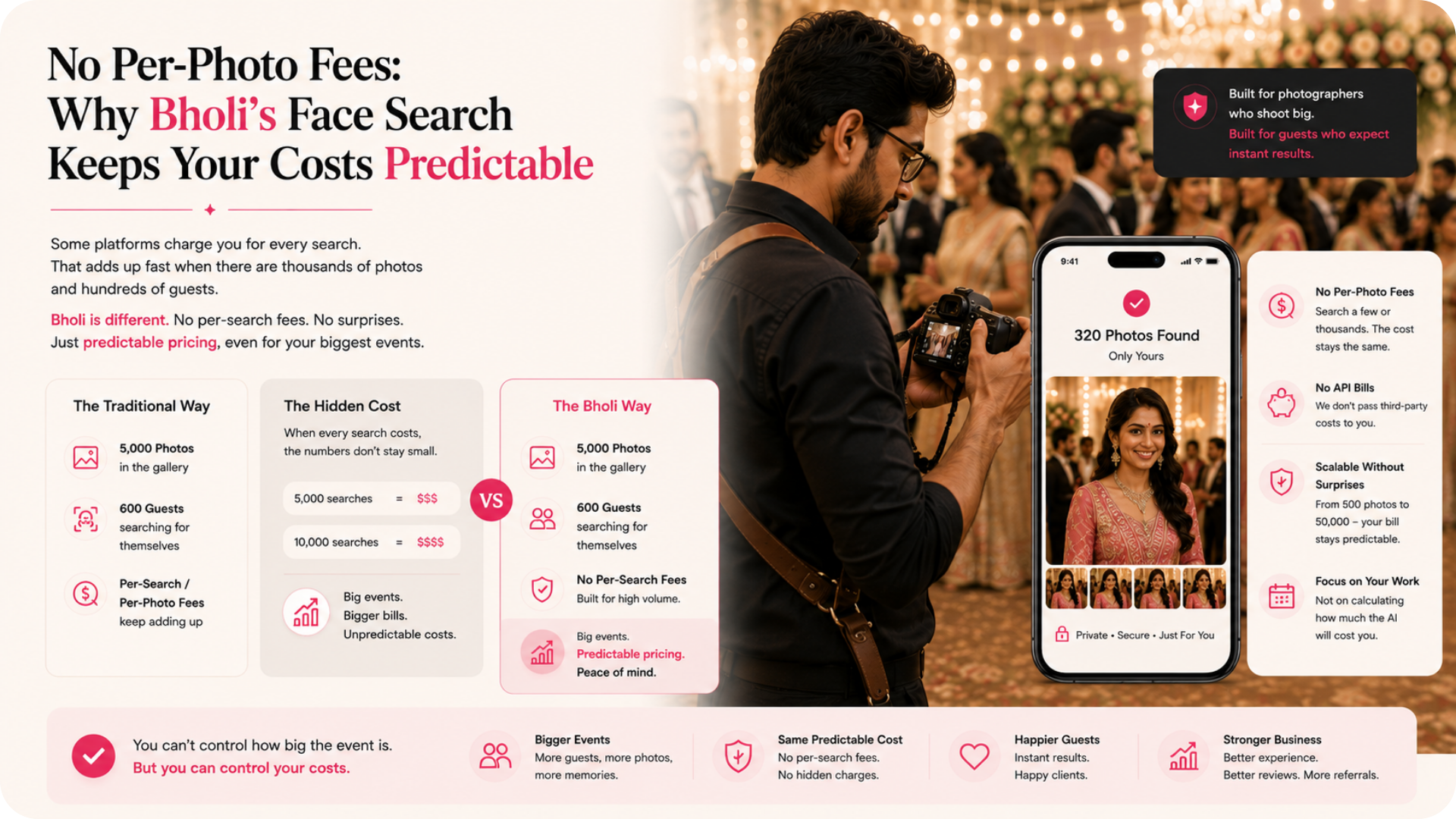
There's a particular kind of unpleasant surprise that hits photographers who lean on "AI" tools: the bill.
It usually goes like this. You try a feature, it works beautifully on a small job, you're delighted. Then you run it across a real event - a few thousand photos, a big crowd - and a month later there's a charge that's bigger than you expected, because somewhere in the fine print, that clever feature was billing you per photo or per use. What felt free at 200 photos is a real number at 15,000.
It's worth understanding why that happens, and why Bholi's face search is built to avoid it.
The hidden meter behind a lot of "AI"
Many AI features don't actually run on the platform you're using. They quietly call out to a third-party service in the background, and that service charges for every single call - every photo analysed, every search run. The platform passes that cost along to you, sometimes visibly, sometimes baked into usage limits you bump into at the worst moment.
At low volume you never notice. The trouble is that event photography is high volume by nature. A wedding is thousands of photos. A marathon is tens of thousands. So a per-photo cost that's invisible on a portrait shoot becomes a genuine line item the moment you do the work you actually do.
And it's unpredictable, which is almost worse than expensive. You can't quote a client confidently when you don't know what your own delivery will cost until the bill arrives.
How Bholi's face search is different
Bholi's face search isn't a meter running in the background. It's built into the platform rather than renting someone else's per-call service for every face it looks at - so indexing the photos and letting guests find themselves doesn't rack up a charge that scales with how many photos you shot.
The practical upshot: a fifteen-thousand-photo race doesn't cost dramatically more to make searchable than a small event does. Your delivery cost doesn't balloon just because you had a big, successful shoot - which is a strange thing to be penalised for, when you think about it.
Why predictable beats cheap
Notice the word I keep using: predictable. That matters more than "cheapest," and here's why.
As a working photographer, you price jobs in advance. You quote a couple, you bid for a corporate contract, you agree a rate with a race organiser - all before you've pressed the shutter. If your own delivery costs are a moving target that spikes with volume, every quote is a quiet gamble. You're either padding your prices to be safe (and losing bids) or eating surprise costs (and losing margin).
When the cost of making an event searchable doesn't swing wildly with photo count, you can quote with confidence. You know your number. You keep your margin on the big jobs instead of watching it get nibbled away by a per-photo meter.
The honest version
To be straight about it: no platform is free to run, and Bholi has its own pricing like anything else. The point isn't "it costs nothing." The point is how it costs - a predictable arrangement rather than a hidden meter that punishes you for volume.
For a photographer whose whole business is volume, that's not a minor detail. It's the difference between a tool you can build a pricing model around and a tool that springs a number on you after the fact. And for the part of your work that touches the most photos - making them findable - predictable is exactly what you want.
pricing your packages
Related Articles
The Real Cost of Slow Delivery: A Referral Math Breakdown
Most photographers think slow delivery costs them nothing. It's just time, right? You'll get the gallery out eventually, the client will be happy enough, and life goes on.
How to Charge for Premium Delivery Without Losing Bookings
Here's a quiet truth about photography pricing: most photographers give away the part clients would happily pay extra for.
How to Get Your Studio Found by AI Search (ChatGPT, Perplexity & Google)
The way people find a photographer is quietly changing, and most studios haven't noticed yet. That's good news - it means there's a head start available to whoever moves first.