
The Real Cost of Slow Delivery: A Referral Math Breakdown
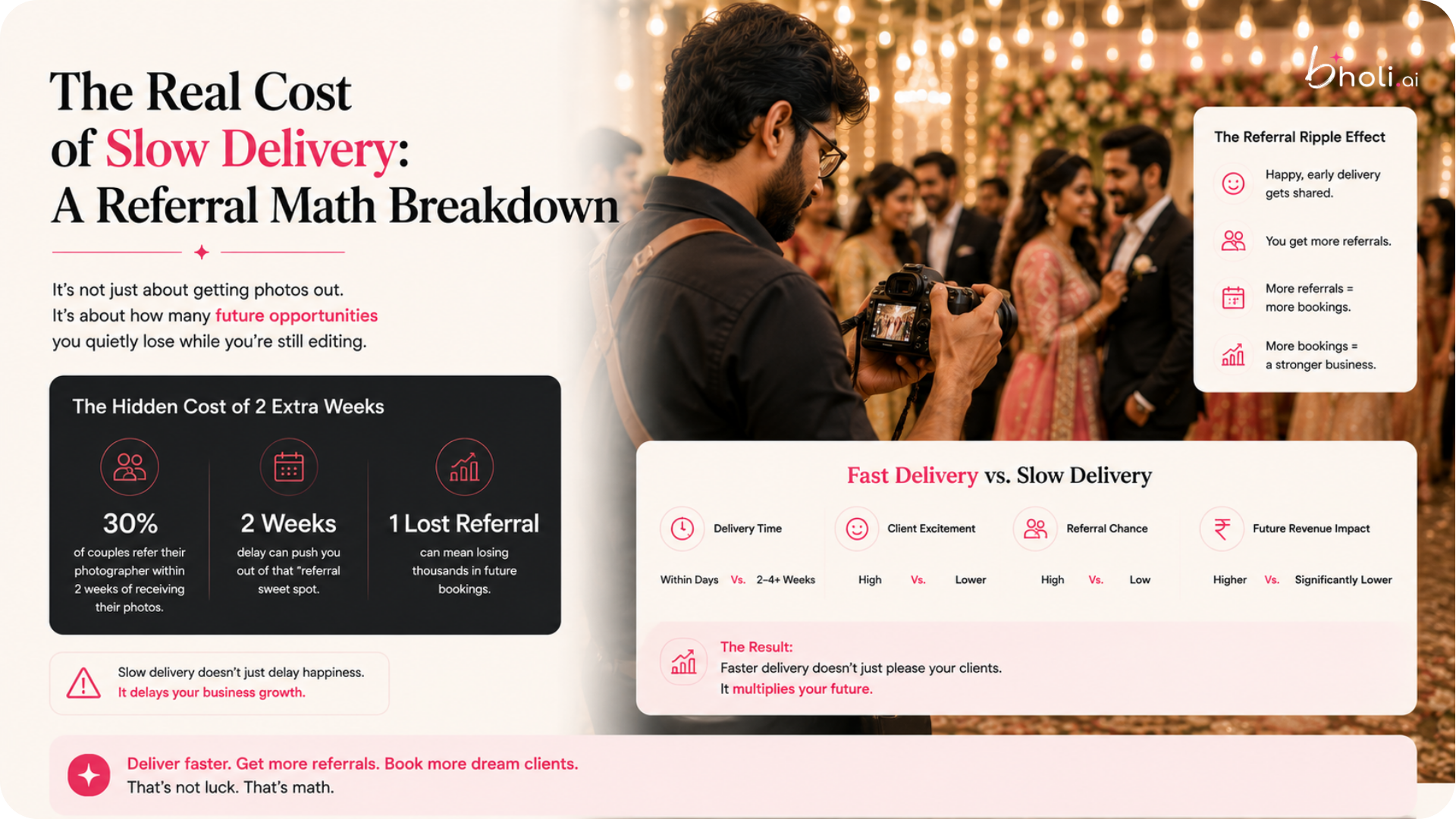
Most photographers think slow delivery costs them nothing. It's just time, right? You'll get the gallery out eventually, the client will be happy enough, and life goes on.
Let's actually do the math, because the cost is real - it's just invisible, which is the most dangerous kind. It doesn't show up as a bill. It shows up as bookings that never happened, and you never find out they didn't.
Grab your own numbers and follow along. I'll use round example figures; you substitute yours.
Where photographer bookings actually come from
Ask working photographers where their clients come from and you'll hear the same answer over and over: referrals. Someone went to a wedding, saw the photos, asked "who shot this?", and called you. Word of mouth is the cheapest, highest-converting marketing you have, and you don't control it directly - you can only feed it.
So the real question is: what feeds referrals? People sharing your photos. And what makes people share photos? Getting them while they still care.
That's the whole chain: fast delivery → more sharing → more people see your work → more referrals → more bookings. Slow delivery quietly breaks the chain at the first link.
The worked example
Say a wedding has 300 guests. Picture two scenarios.
Scenario A - delivery three weeks later. By the time the gallery lands, the buzz is gone. People glance, maybe download a couple, and move on. Let's say 10% bother to share anything publicly - so roughly 30 guests post or forward a photo.
Scenario B - delivery during or right after the event. The excitement is still live, phones are out, the group chats are buzzing. Sharing is far higher - let's say 40% share something, so around 120 guests.
That's a difference of about 90 extra guests putting your work in front of their networks. Plug in your own share rates if you have them; the gap is the point.
Now the funnel. Suppose every shared photo reaches, conservatively, 50 people in that guest's circle. 90 extra sharers × 50 = 4,500 extra impressions on your work - for this one wedding - that simply don't exist in the slow-delivery world.
Say a tiny fraction act: 0.2% reach out, and a quarter of those book. That's 4,500 × 0.2% = 9 enquiries, and ~2 bookings.
Two extra weddings. From one event. Just from delivering faster.
If your average wedding is ₹80,000, that's ₹1,60,000 of business you didn't lose to a competitor - you lost it to a three-week delay. And this was one wedding. Run it across a year of events and the slow-delivery tax gets genuinely frightening.
The numbers are illustrative - the mechanism is not
Don't get hung up on my exact percentages; yours will differ, and you should use yours. The mechanism is what's solid: faster delivery means more sharing while attention is hot, more sharing means more reach, more reach means more referrals, and referrals are where your bookings actually come from.
The delay doesn't cost you time. It costs you the compounding - every wedding you deliver slowly is a wedding that fed your pipeline less than it could have, forever.
What this means in practice
You don't fix this by working faster or skipping sleep. You fix it by closing the gap between the shutter and the share - getting at least some photos in front of guests while the event is still warm, so the sharing happens at peak excitement instead of three weeks into indifference.
The photographers who win the referral game aren't necessarily the best shooters in town. They're the ones whose work is seen, by the most people, while those people still care enough to pass it on.
Slow delivery isn't free. It's just billed to an account you can't see - and it's bigger than the time you thought you were saving.
Related Articles
How to Charge for Premium Delivery Without Losing Bookings
Here's a quiet truth about photography pricing: most photographers give away the part clients would happily pay extra for.
No Per-Photo Fees: Why Bholi's Face Search Keeps Your Costs Predictable
There's a particular kind of unpleasant surprise that hits photographers who lean on "AI" tools: the bill.
How to Get Your Studio Found by AI Search (ChatGPT, Perplexity & Google)
The way people find a photographer is quietly changing, and most studios haven't noticed yet. That's good news - it means there's a head start available to whoever moves first.