

The Most Expensive Part of Your Job Has Nothing to Do With Your Camera
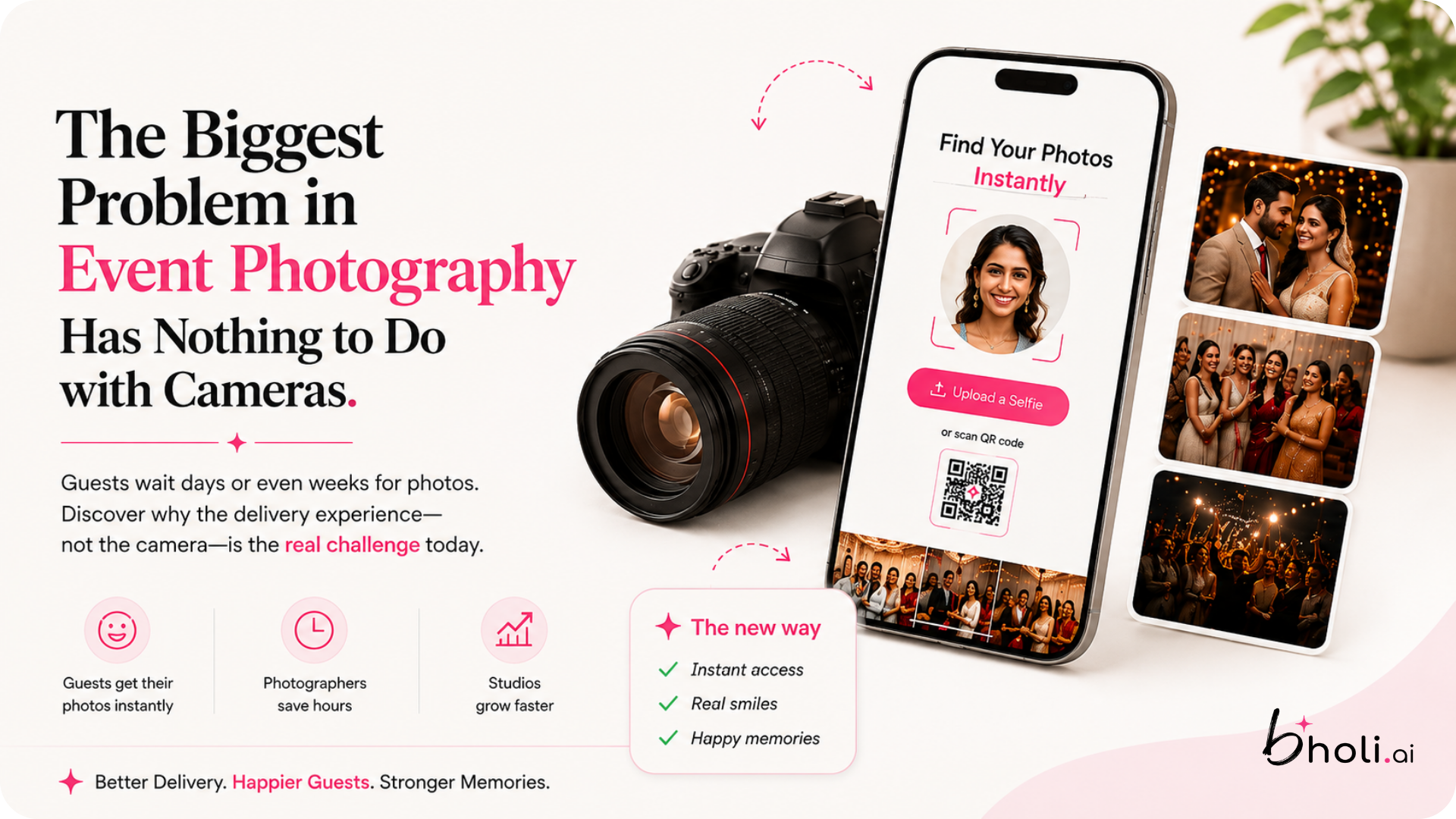
You spent eight months deciding between two camera bodies. You read every review, watched every pixel-peeping YouTube comparison, maybe lost a little sleep over it. Fair enough - it's a serious tool and it cost serious money.
Now answer this honestly: how long did you spend deciding how your clients would actually receive their photos?
If the answer is "I just send a Google Drive link," you're not alone. You're also leaving money on the table - and you probably can't see it, which is exactly why it's a problem.
The three weeks nobody puts on the invoice
Picture a wedding. 600 guests, two shooters, somewhere north of 5,000 frames. You nail it. The light cooperates, the couple cries at the right moment, the dance floor goes off. By Monday you're proud of the work.
Then comes the part nobody talks about at photography workshops.
The culling. The editing. The "client wants to approve before we share." The upload that crashes at 80%. And the messages - oh, the messages. The bride's cousin who slid into your DMs. The "Photos kab milenge?" on day three, then day six, then a slightly passive-aggressive day eleven.
Two, three weeks later, the gallery goes out. The photos are gorgeous. And almost nobody reacts the way they would have on Monday, because by now the wedding feels like something that happened to other people.
And yes, the industry has gotten faster - the average wait has fallen from two or three months a few years ago to two or three weeks today. Real progress. But two or three weeks is still long after the moment passed. That gap - between the moment and the memory landing in someone's hands - is the most expensive thing in your business. It just never shows up on the invoice.
Why the wait quietly costs you
Here's the uncomfortable bit. The cost of slow delivery isn't really about your time (though that matters). It's about momentum.
For about a week after any event, people are primed to share. The group chats are alive, the stories are going up, everyone's still buzzing. A photo dropped into that window gets posted, tagged, forwarded, made into a profile picture. A photo dropped three weeks later gets a polite "wow, lovely 🙂" and a download nobody opens again.
Same photo. Completely different life.
And every share you miss is a quiet little ad you didn't run. Every guest who doesn't post your work is a future client who never found out you exist. You didn't lose a sale. You lost the chance of a sale - which is worse, because you'll never even know it happened.
Nobody actually wants 5,000 photos
This is the part photographers resist, so let me say it plainly: your clients don't want all the photos. They want their photos.
The aunt wants the four shots she's in. The best man wants the speech and the chaos that followed. The bride wants everything, sure - but even she opens the gallery and immediately hunts for her face first. (There's actual psychology behind that, but that's another post.)
When you hand someone 5,000 images, you haven't given them a gift. You've given them homework. And then we wonder why engagement drops off a cliff after the first 200 thumbnails.
The photos existing was never the problem. People finding the ones that matter to them - fast, on their phone, while they still care - that's the whole game.
The craft is solved. The handoff isn't.
Think about how far the rest of your kit has come. Autofocus that locks onto an eye across a dark mandap. Editing that used to take a weekend now half-done by the time you've had chai. Storage so cheap it's basically free.
Every link in the chain got faster and smarter - except the last one. The handoff. The bit where the work actually reaches a human being. That's still running on 2015 technology: upload a giant folder, paste a link, cross your fingers.
That's the bottleneck. Not your camera. Not your editing. The delivery.
So what do you actually do about it?
Not "shoot faster" - please don't. The answer isn't rushing the craft. It's shrinking the distance between the shutter and the smile:
a. Get photos in front of guests while the event is still warm, not three weeks cold.
b. Let each person find themselves in seconds instead of scrolling for twenty minutes.
c. Make the whole thing happen on a phone, because that's where every single one of
your guests already is.
Do that, and something funny happens. The complaints stop. The sharing goes up. And the referrals you were burning ad money to chase start arriving on their own - because 600 happy guests just became 600 tiny billboards, working for free, while the wedding is still the talk of every group chat.
Here's the business case in one line: faster delivery isn't a nicety, it's your cheapest marketing channel. Every gallery that lands late is a stack of referrals you quietly left on the table - and a booking your competitor gets instead. You'll never see the invoice for it, but you're paying it every single event.
Your camera takes the photo. But delivery decides whether anyone ever sees it, shares it, or sends you the next client because of it.
And right now, for most studios, that's the cheapest growth lever sitting in plain sight.
Related Articles
Wedding Photo Delivery Went From 3 Months to 3 Weeks. Here's the Gap That's Still Open.
If you've been shooting weddings for a few years, you've felt this without measuring it: the wait for photos has been shrinking. What used to be a sheepish "give me a couple of months" is now a confident "two to three weeks." That's real progress, and the data backs it up.
What "AI Photo Delivery" Actually Means for Your Studio
"AI" is doing a lot of heavy lifting in marketing these days, and most of the time it means very little. So before you roll your eyes at another tool claiming to be AI-powered, let's define "AI photo delivery" in plain terms - what it actually is, what it isn't, and what changes for your studio if you adopt it.