

Wedding Photo Delivery Went From 3 Months to 3 Weeks. Here's the Gap That's Still Open.
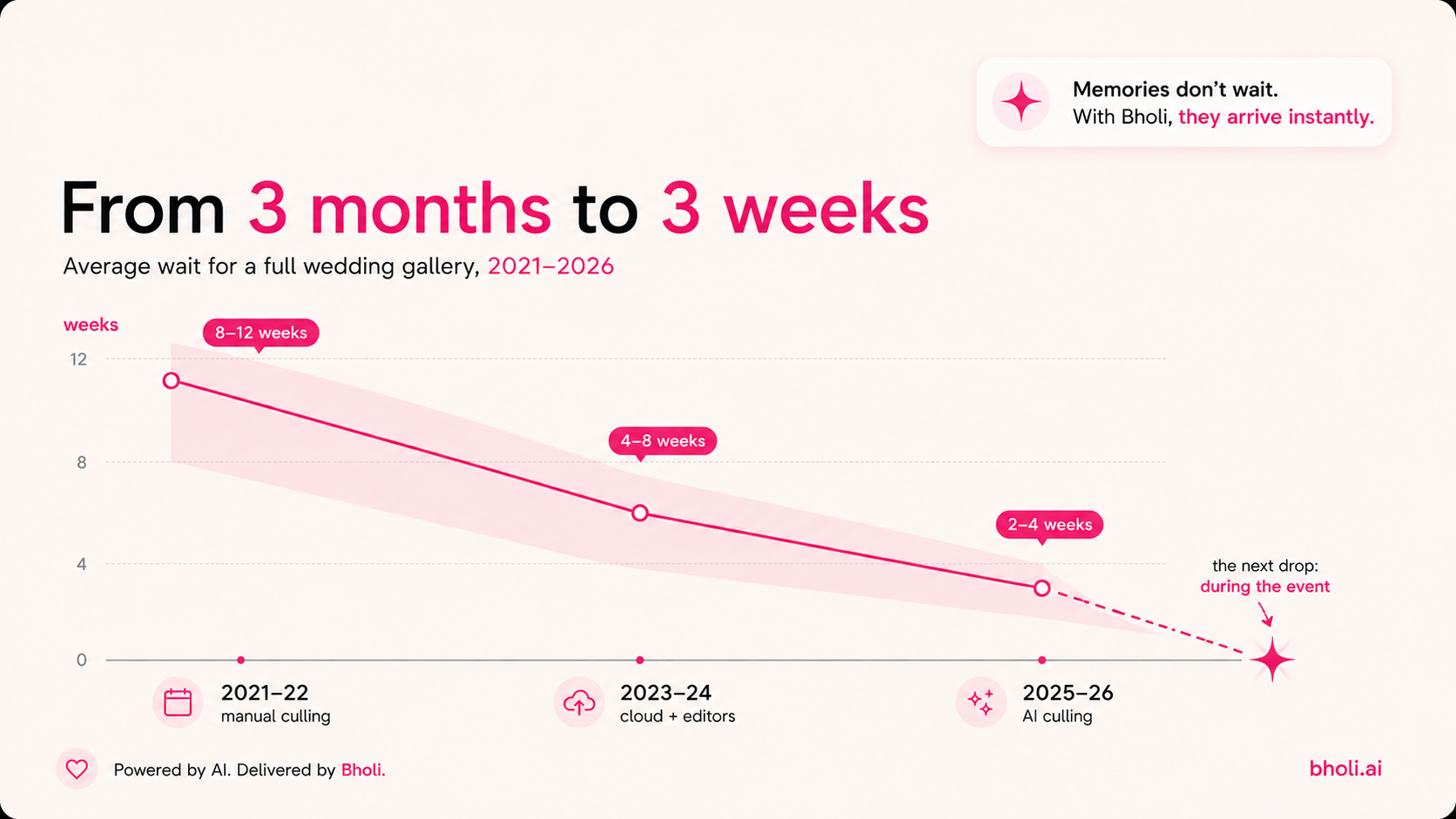
If you've been shooting weddings for a few years, you've felt this without measuring it: the wait for photos has been shrinking. What used to be a sheepish "give me a couple of months" is now a confident "two to three weeks." That's real progress, and the data backs it up.
But the same data hides a twist most photographers haven't clocked - where all that improvement actually came from, and the one part of delivery that's barely budged. Let's look at the numbers, then the part nobody's talking about.
Five years of delivery times falling
Here's how the average wait for a full edited gallery has moved across the Indian wedding industry:
| Period | Average wait (full gallery) | What drove it |
| 2021–2022 (post-pandemic boom) | 8–12 weeks (2–3 months) | Back-to-back wedding dates created severe backlogs; culling thousands of photos was entirely manual. |
| 2023–2024 (the tech transition) | 4–8 weeks (1–2 months) | Cloud hosting and rapid "sneak peek" packets arrived; teams began using external editors. |
| 2025–2026 (the AI wave) | 2–4 weeks (15–30 days) | AI culling and colour tools made the editing stage dramatically faster. |
That's a striking collapse - roughly a 75% cut in five years. But each drop has a specific, very Indian story behind it.
Why 2021–2022 took 8–12 weeks
It sounds like a long time until you remember what an Indian wedding actually is. Unlike a single-day Western celebration, a traditional Indian wedding spans three to five separate events - Haldi, Mehendi, Sangeet, the wedding, the reception - and that yields a staggering data footprint, often 8,000 to 12,000 RAW frames per client.
The post-pandemic era then created a historic volume crisis, packing an unprecedented number of weddings into a limited set of auspicious saya dates. Data tracking from major wedding-technology portals like WedMeGood shows how peak seasons drastically overwhelmed independent creative businesses. And because curation - manually filtering duplicates, blinks, and lighting-test frames - was entirely human-dependent, deep backlogs accumulated by mid-season. A turnaround of two to three months wasn't laziness; it was raw human hours failing to keep pace with the wave of data. Eight to twelve weeks simply became the accepted benchmark.
Why 2023–2024 dropped to 4–8 weeks
As high-speed mobile data and internet penetration expanded across Tier-1 and Tier-2 cities, client expectations underwent a sharp psychological shift toward instant gratification - a rise in demand for digitisation and real-time tracking highlighted in national market analysis such as Grand View Research's report on India's wedding services market.
To manage client anxiety during peak seasons, studios moved away from couriered USB drives toward early cloud-hosted galleries. This era popularised the "WhatsApp sneak peek" - a packet of 30–50 highlight images rushed to the couple within 72 hours. But that sneak peek was a patch, not a fix: the core back-end work of sorting and baseline colour-correcting the entire multi-thousand-image catalogue still ran on traditional desktop batch processing. So full delivery only compressed to four to eight weeks.
Why 2025–2026 is down to 2–4 weeks
Then automation began rewriting the benchmark. According to the WedMeGood 5th Annual Wedding Report (2025), nearly a quarter (24%) of wedding professionals have actively automated their post-production, editing, design, and customer-response workflows - adapting to survive India's roughly ₹6.5 lakh crore wedding economy.
Machine-learning culling has turned a grueling six-hour manual sort into 15–20 minutes, and handles brutal exposure normalisation across chaotic lighting - dark Sangeet stages, harsh outdoor daytime rituals - without breaking a sweat. That back-end revolution is what dropped the standard delivery expectation to two to four weeks.
Where did all that speed actually come from?
Look closely at every one of those drops and a pattern jumps out: the gains came from the editing room. Manual culling became AI culling. Hand colour-correction became one-click colour. The thing that got faster was processing the photos - the back-end work between the shoot and the gallery.
That race is now largely run. But notice what didn't change: the actual act of getting photos to people, and helping each person find the ones they care about. You still finish editing, upload one big gallery, send one link to everyone, and let hundreds of guests scroll. The gallery just arrives sooner.
In other words, we spent five years compressing the editing and left the delivery and discovery almost untouched. The bottleneck didn't disappear. It moved - to what the industry itself now calls the final roadblock: client distribution.
The last bottleneck is discovery
Here's the part the curve is pointing to. Even with a best-in-class two-week gallery, a guest at that wedding still has to open thousands of photos and hunt for themselves - and most give up. The photos arrive faster, but finding your face in 10,000 frames is still a chore nobody finishes.
That's the real frontier now: not editing, and not even raw speed, but discovery - letting each guest find every photo they're in, in seconds, instead of scrolling through thousands. (And once that's solved, delivering those photos live, during the event, is the accelerant on top.)
The last five years fixed how fast photos get processed. The next leap is how effortlessly the right photos reach the right person. Three months to three weeks was the easy 75%. Closing the final gap - discovery - is the part worth fighting for.
Related Articles
The Most Expensive Part of Your Job Has Nothing to Do With Your Camera
You spent eight months deciding between two camera bodies. You read every review, watched every pixel-peeping YouTube comparison, maybe lost a little sleep over it. Fair enough - it's a serious tool and it cost serious money.
What "AI Photo Delivery" Actually Means for Your Studio
"AI" is doing a lot of heavy lifting in marketing these days, and most of the time it means very little. So before you roll your eyes at another tool claiming to be AI-powered, let's define "AI photo delivery" in plain terms - what it actually is, what it isn't, and what changes for your studio if you adopt it.