

Your Clients' Private Moments Shouldn't End Up on a Stranger's Phone
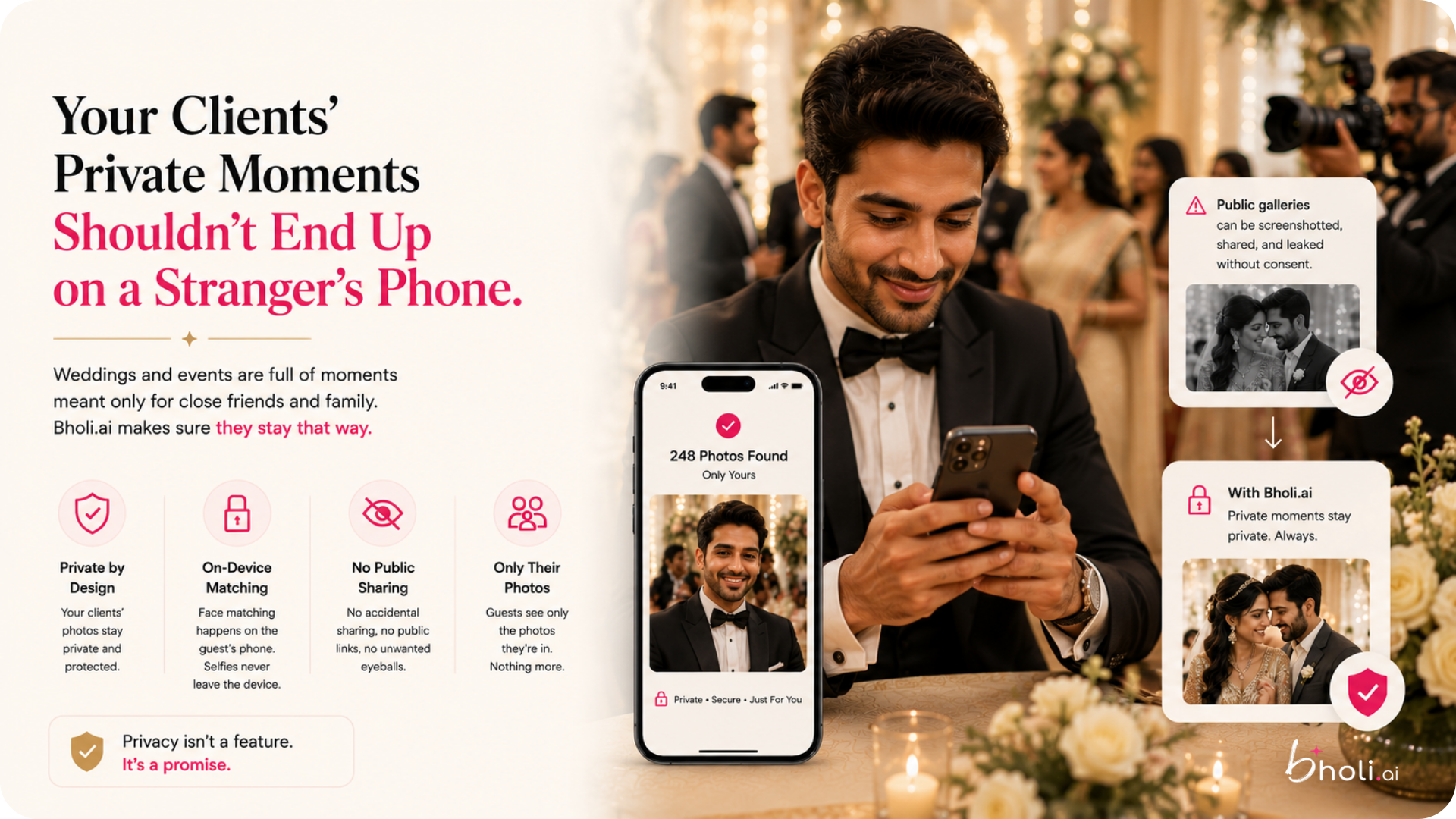
A wedding gallery is one of the most intimate things a person ever hands to a stranger - and that stranger is you.
Think about what's actually in it. A bride getting ready, half-dressed, laughing with her sisters. A father's face the moment he sees his daughter. Children running around. Quiet, unguarded seconds that the people in them would never post publicly, but treasure privately. They're trusting you with all of it.
So here's a question most photographers don't think about until something goes wrong: once you deliver those photos, who else can see them - and where could they end up?
The quiet ways private photos travel
It's rarely malicious. It's casual. Someone forwards the gallery link to a friend "just to show them." The link works for that friend too, and their friend, and now a private wedding is a few taps from people who were never invited. Somebody screenshots a candid and drops it in a group chat for a laugh. A photo of someone's kid floats somewhere the parents never agreed to.
Nobody set out to do harm. But a private moment quietly became a public one, and the couple who trusted you are the last to know.
For most ways of delivering photos - a folder link that works forever, a gallery anyone can screenshot freely - this is just… how it is. And that's a problem, because the whole value of an intimate photo is that it stays intimate.
What protecting the photos actually means
This isn't about stopping sales. Bholi.ai isn't a shop, and nobody's trying to force a guest to "buy" their own memories. It's about something simpler and more human: helping you keep a private gallery actually private.
A few things make a real difference:
- Galleries that aren't open to the world. Access can be locked behind a PIN, so a forwarded link alone isn't a skeleton key to someone's wedding.
- Links that expire. Instead of a URL that works forever and spreads forever, access can be time-limited - so an old link doesn't become a permanent open door.
- Screenshot resistance. The platform actively makes casual screenshotting harder - blocking the quick right-click, the print-screen, the easy grab-and-share that accounts for almost all of it.
Together, these don't turn a gallery into a vault. They turn it from "anyone, forever" into "the people who should see it, while they should see it."
Let's be honest about the limits
Here's the part a lot of "100% protected" marketing won't tell you, and the part that actually earns trust: no system can make a digital photo impossible to capture. If someone is truly determined, they can point a second phone at the screen and photograph it. That's true of every platform on earth.
What protection does is stop the casual leak - the thoughtless forward, the reflexive screenshot, the link that travels further than anyone intended. And since almost all privacy slips are careless rather than deliberate, closing the easy doors closes the vast majority of the risk. Anyone who promises more than that is overselling.
Why this is really a trust feature
Step back and this isn't a security feature at all. It's a relationship feature.
When a couple asks "who's going to be able to see these?" - and the good ones do ask - you want a real answer. "The gallery's locked, the link can expire, casual screenshotting is blocked, and it's not floating around the open web" is a genuinely reassuring thing to be able to say. It tells the client you take their privacy as seriously as their photos.
That reassurance is worth more than any feature list. People don't just hire a photographer for the camera. They hire someone they can trust with the most personal day of their life. Being able to promise that trust is kept - long after you've packed up and gone home - is a quietly powerful reason to book you over the photographer who shrugs and sends a link that works forever.
Their moments were private when you captured them. The least we can do is help them stay that way.