

Is Face Search Safe? A Straight Answer on Privacy
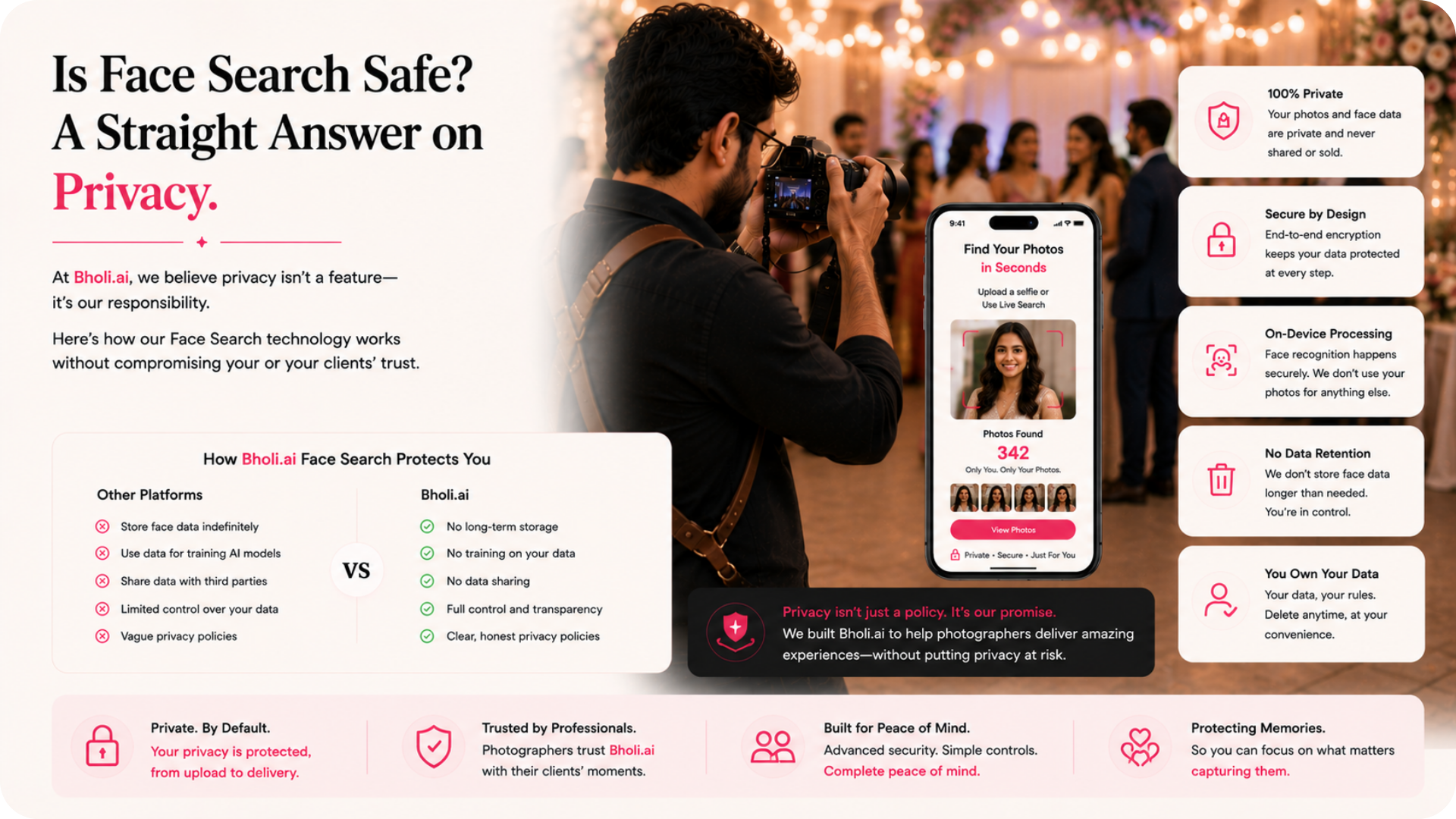
Say the words "face recognition" and people picture the wrong thing. CCTV. Governments. A database somewhere with their name on it. So when you tell a couple their wedding gallery uses face search, it's fair if their first reaction is a slightly nervous "…wait, how does that work?"
Good. That's exactly the right question, and you should have a clear, honest answer ready - because being able to reassure your clients is part of the service now. Here's the straight version.
A selfie to find photos is not the same as surveillance
The fear comes from imagining a permanent system that watches people and remembers who they are forever. That's not what's happening here.
What's happening is narrow and temporary: a guest chooses to take a selfie, the system uses it to find their photos in that one event, and then it's done. There's no name attached, no profile being built, no cross-event tracking. It's a search, not a watchlist. The guest is looking for themselves on purpose - not being looked for.
That distinction matters, and it's worth saying to clients in plain words: this finds your photos at your event; it isn't tracking you anywhere else.
The strongest privacy option: the selfie never leaves the phone
Here's the part worth understanding properly, because it's a genuine advantage.
Face matching can run in two ways. One processes things on the server. The other - the privacy-first mode - runs the matching right inside the guest's own browser, on their own device. In that mode, the selfie doesn't get uploaded anywhere. It's used on the phone to find matches and then it's gone. Nothing to store, nothing to leak, because it never travelled in the first place.
For a wedding full of family, or a school event full of children, that's not a technicality - it's the kind of thing you can say out loud to put a worried parent completely at ease.
What happens to the data, honestly
A few grounded specifics you can point to (and should confirm against your current setup before quoting them publicly):
- Search results don't linger. A guest's search results expire after a short window rather than sitting around indefinitely.
- Face data is tied to the event. When an event is deleted, the associated face data is cleaned up with it - it's not kept forever "just in case."
- There are limits against abuse. Searches are rate-limited, so nobody can sit there hammering the system trying to fish through an event.
None of that is exotic. It's just privacy treated as something you design in, rather than a checkbox you tick at the end.
A note on the compliance word
You'll be tempted to write "GDPR compliant" on everything. Be a little careful there - compliance depends on how you configure and use the platform, what you tell guests, and your own local rules. It's more honest, and frankly more reassuring, to say something like "built to be privacy-first, with options designed with regulations like GDPR in mind." That's a promise you can actually keep, and clients trust the photographer who doesn't over-claim.
The reassurance, in one breath
If a client asks, here's the whole answer in plain language:
"It only finds photos from your event. People search for themselves by choice. With the privacy mode, their selfie never even leaves their phone. Results don't hang around, and when the event's gone, the face data goes with it."
Say that, and "face recognition" stops sounding like surveillance and starts sounding like what it actually is - a faster, kinder way for your guests to find themselves. The technology is only worth using if people trust it, and trust comes from being able to explain it simply and honestly. Now you can.