

Marathon & Sports Photographers: Sorting 15,000 Photos by Runner, Automatically
Wedding photographers complain about volume. Then they meet a marathon photographer.
A single race can leave you with fifteen thousand photos and five thousand runners, all in matching kit, half of them mid-stride with a number pinned to their chest and an expression somewhere between determination and regret. Every one of those runners wants their photos. And historically, the way they got them was somewhere between tedious and cruel.
If you shoot races, sports days, triathlons, cycling events - anything with a crowd of competitors and a mountain of frames - this one's for you. Because the old workflow was never really a workflow. It was a sentence.
The bib-number sorting prison
The traditional approach to race photography is built around bib numbers. You shoot thousands of runners, then someone - often you, often at 1 a.m. - sorts photos by the number on each chest so runners can look themselves up. It's slow, it's error-prone, and it falls apart the second a number is blurred, turned, sweated-through, or hidden behind a flailing arm at the exact moment you pressed the shutter.
So runners end up squinting through endless grids hoping to spot themselves, or typing in a bib number that may or may not be readable in the one good shot you got of them. Plenty just give up. Your best frame of someone's personal-best finish line sits unfound forever.
There's a faster way, and it doesn't care about bib numbers at all.
Let the photos sort themselves - by face
Here's the shift. Instead of organising by the number on a runner's chest, Bholi.ai organises by the runner.
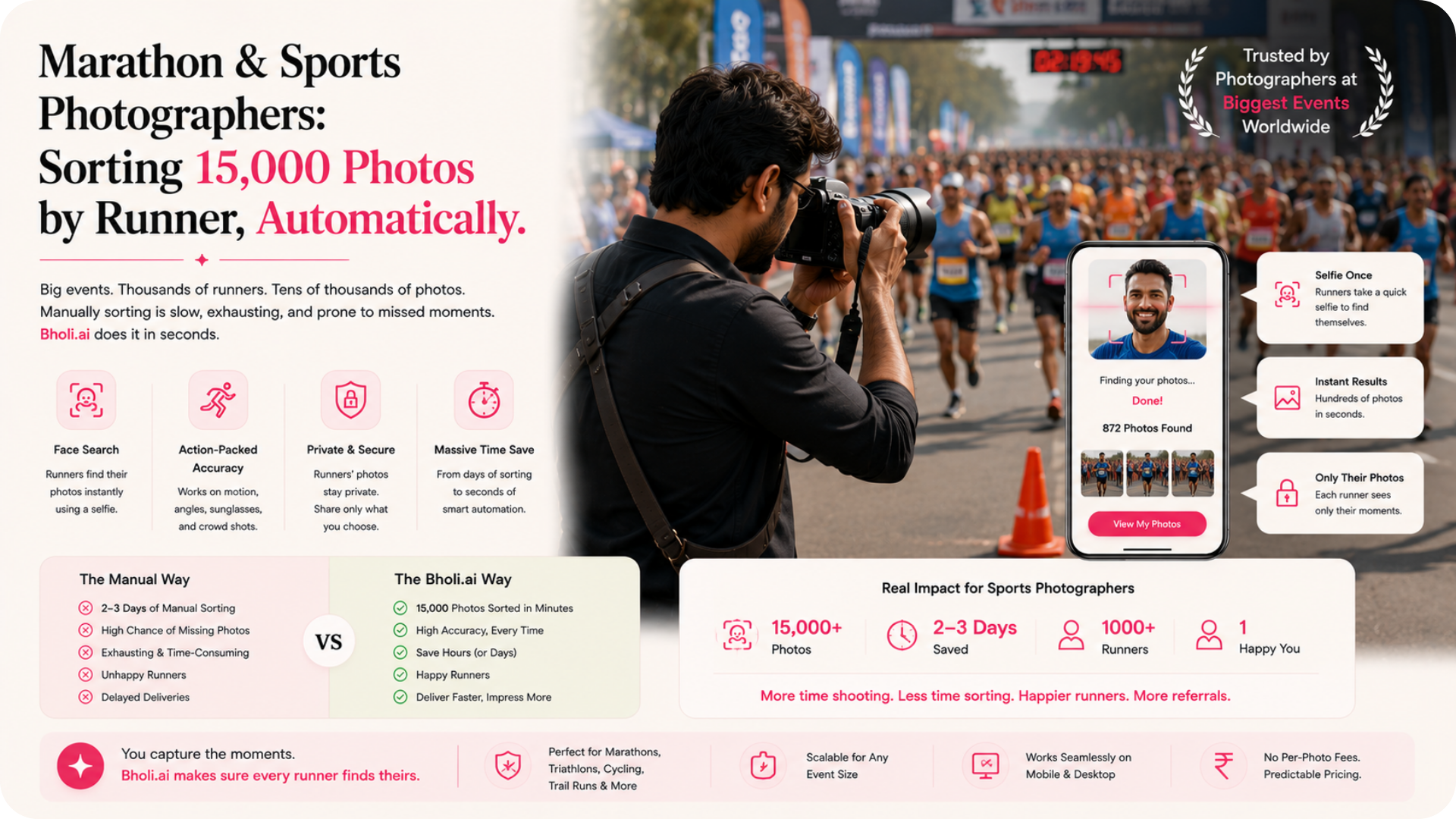
Upload the whole race - and at this scale you'll lean on bulk and ZIP uploads, plus chunked uploads that don't choke or corrupt when you're pushing fifteen thousand high-res files over questionable event WiFi. As the photos process, the system notices every face and groups the entire event by person, automatically. No tagging. No bib-number spreadsheet. No 1 a.m.
Then the runner does the easy part. They scan a QR code - on the race bib, the finisher email, the results page - take a selfie, and instantly see every photo they're in, blurred number or not. The face was always more reliable than the bib anyway.
What used to be days of sorting becomes minutes of processing. What used to be a runner's frustrating treasure hunt becomes three seconds.
The cost detail that actually matters at this scale
Volume is where a hidden problem usually bites. A lot of "AI" photo features quietly charge you per photo or per search through someone else's service - barely noticeable at 200 photos, genuinely painful at fifteen thousand. Process a few big races a month that way and you've got a surprise bill that eats your margin.
Bholi's face search doesn't carry those repeating per-photo fees. A fifteen-thousand-photo race doesn't spike your costs the way a metered service would. For a high-volume shooter, predictable cost isn't a footnote - it's the difference between scaling up and being scared to.
Why it wins you the next event
Race organisers care about one thing after the finish line: were the runners happy? When competitors can find their photos in seconds - fast, on their phones, while the medal's still around their neck and they're still buzzing - that satisfaction reflects straight back on the event and on you.
The organiser who watched runners delight in finding themselves instantly is the organiser who books you for next year's race, and recommends you for the three others they help run. In a field where most photographers are still trapped in bib-number sorting, "your runners will find themselves in three seconds" is a genuinely strong pitch.
You did the hard part out on the course. Let the sorting do itself.
Related Articles
Corporate & Conference Photographers: Secure, Branded, Same-Day Delivery
Corporate clients are a different animal from wedding couples, and if you shoot events for companies you already know it.
School & Graduation Photographers: Help Parents Find Their Child - Safely
School photography comes with a responsibility that wedding and corporate work doesn't: the people in your photos are children. That changes the job. Before "fast" or "clever" or "delightful," the first word has to be safe.