

The First Face You Look For in Any Photo Is Your Own
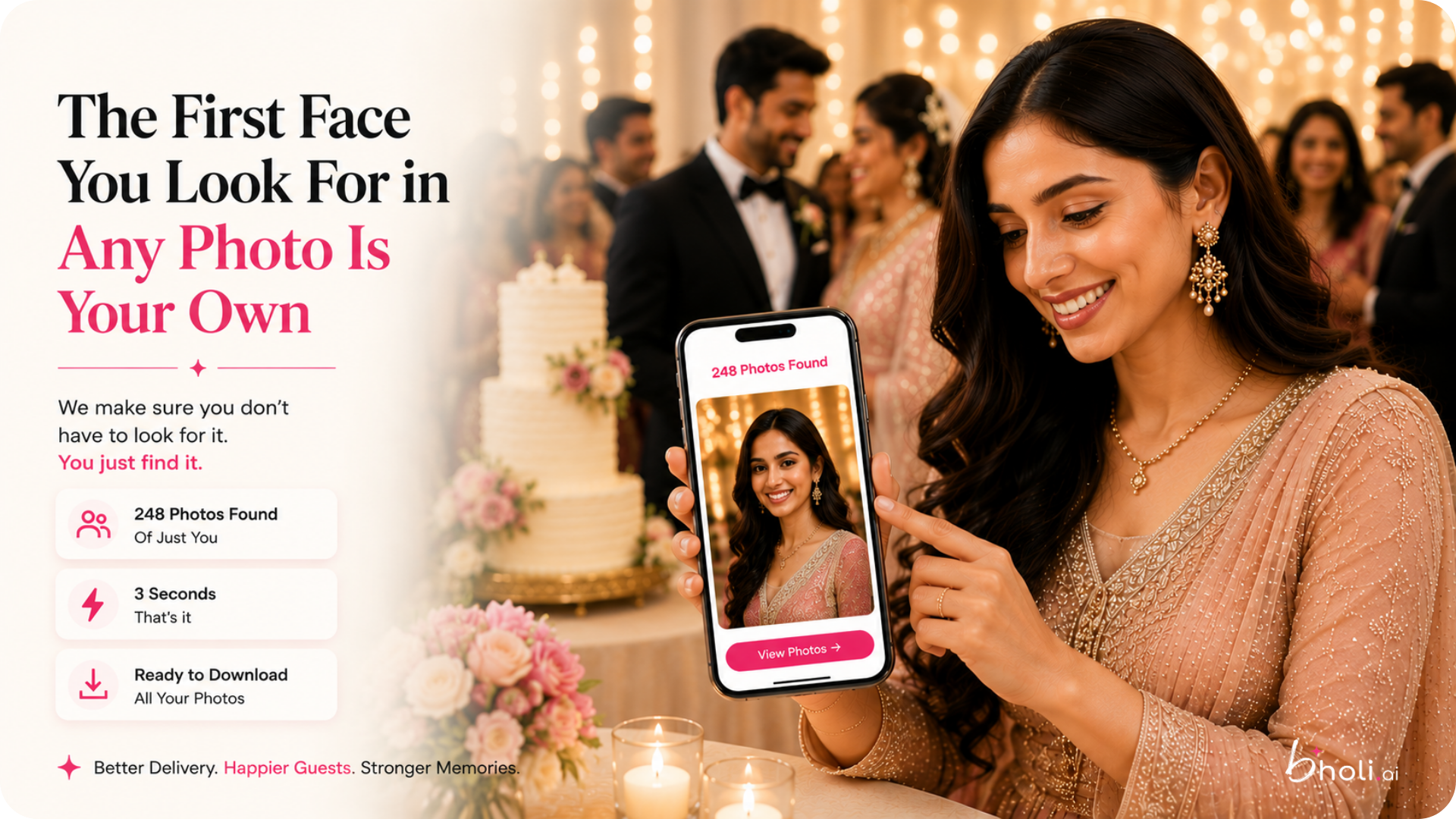
Try this. Next time someone shares a group photo from an event - a wedding, an office party, a family function - watch what your eyes do in the first half-second.
You don't admire the lighting. You don't notice the decor the planner stressed over for months. You don't even register half the people in the frame.
You find yourself. Instantly. Out of forty faces, your brain locks onto one like it's got a homing signal.
And here's the strange part: you didn't decide to do that. Nobody does. We all just… do it.
It's not vanity. It's wiring.
Before you feel bad about it, you should know psychologists have a name for this, and it's not "being self-obsessed." It's the self-reference effect - the well-documented fact that the human brain pays more attention to, and remembers better, anything connected to itself.
It makes sense when you think about it. You've experienced your entire life from exactly one point of view - your own. Every memory you have is filmed from behind your eyes. So when a photo offers you the rare chance to see yourself from the outside, in a moment you actually lived, your brain treats it like important information. Because to you, it is.
This is also why a slightly blurry photo of you laughing can mean more than a technically flawless shot of someone else's first dance. The image quality isn't doing the heavy lifting. The relevance is.
Now here's why this should keep photographers up at night
Picture the gallery you just delivered. Five thousand photos. One link, sent to everyone.
Every single person who opens it is running that same self-reference program in their head. The aunt isn't browsing your portfolio - she's hunting for the four frames she's in. The groom's college friend wants the table shots and the after-party chaos, nothing else. Even the bride, who genuinely wants everything, opens the gallery and looks for her face first.
So you've got 600 people, each desperate to find a different handful of photos… and you've handed all 600 the exact same wall of 5,000 thumbnails and said "good luck."
That's not a delivery experience. That's a search problem dressed up as a gift.
And human attention being what it is, most people give up. They scroll for a bit, find a few of themselves, get tired somewhere around thumbnail 300, and close the tab. Your best frames - the ones they'd have loved, shared, framed - sit there undiscovered. A great photo nobody finds may as well not exist.
"Browse everything" was never the right ask
For years we built galleries the way a librarian organizes a library: neat folders, clear albums, everything in its place. Reception. Haldi. Family. Candids. Logical, tidy, photographer-brain approved.
The problem is, guests don't think in folders. They think in faces. Yours, mine, theirs. Nobody opens a gallery wondering "which folder holds the reception?" They wonder "where am I?"
When the way you deliver photos fights against basic human wiring, the wiring wins. Every time.
The fix is almost embarrassingly simple
Stop asking people to browse, and start helping them find themselves. That's it. That's the whole insight.
In practice it's almost absurdly easy, and it has a name: face search. A guest takes a quick selfie, and the photos they're actually in surface in seconds. No scrolling marathon. No folder archaeology. Just - oh, there I am. (If you're curious how that works under the hood, that's its own post - but the short version is: the gallery already knows which face is where, so it just shows you yours.)
Do that and you're not fighting the self-reference effect anymore. You're working with it. The photo becomes relevant in the first three seconds, the little hit of recognition fires, and that's the moment people share, tag, and talk about your work.
The most powerful thing in your gallery isn't your sharpest image. It's the half-second when someone spots their own face and feels something.
Build your delivery around that half-second - let people find their own face instead of hunting for it - and the rest of it (the sharing, the buzz, the referrals) tends to follow on its own. That's not a nice-to-have feature. It's just finally delivering photos the way the human brain was always going to look for them.
Related Articles
Why Event Photos Outlive Every Social Media Post
Scroll back through your camera roll to a post you made two years ago. A story, a reel, something you put real thought into at the time. Do you remember it? Probably not. It got its likes, did its little lap of attention, and vanished. That's what social content is built to do - burn bright, then disappear.
Photos Kab Milenge? - The Question Every Indian Photographer Dreads
If you've shot a single Indian wedding, you know this message. You can probably hear it in a specific relative's voice.