

Why Event Photos Outlive Every Social Media Post
Scroll back through your camera roll to a post you made two years ago. A story, a reel, something you put real thought into at the time. Do you remember it? Probably not. It got its likes, did its little lap of attention, and vanished. That's what social content is built to do - burn bright, then disappear.
Now think about a photo from a wedding, a graduation, a family gathering. You don't scroll past those. You stop. You feel something. Years later, those are the images people print, frame, set as their phone wallpaper, cry over a little.
Same device. Same person taking pictures. Wildly different shelf life. It's worth understanding why - because if you shoot events for a living, that difference is the entire value of what you do.
Content is for now. Photos are for later.
Social media content has a job: get attention today. It's designed for the scroll - quick, disposable, optimised for a moment of engagement and then gone. That's not a criticism; it's just the format. A post that's still relevant in five years would actually be a strange post.
Event photographs have the opposite job. They're not trying to win today's attention. They're trying to hold a moment so it can be revisited in ten, twenty, fifty years. A wedding photo isn't competing with this morning's reels - it's competing with memory itself, and it's there to win.
One is a firework. The other is a time capsule. People confuse them because they live on the same phone, but they could not be more different in what they're for.
Why the moment matters more than the medium
Here's the thing social content can never replicate: stakes. A reel can be redone. A post can be deleted and reposted. But the father walking his daughter down the aisle happens exactly once. The graduate throwing their cap, the grandmother meeting the baby, the friends collapsing in laughter at 1 a.m. - none of it comes back for a second take.
That irreplaceability is what gives an event photo its weight. It's not just a nice image. It's the only record of a thing that will never happen again. No amount of engagement on a post can compete with "this is the last photo we have of him smiling like that."
This is also why event photos get more precious with time, while social content gets less. The post ages into irrelevance. The photo ages into treasure.
What this means for how you deliver
If event photos are time capsules, then the most important thing isn't just capturing them - it's making sure they actually reach the people who'll treasure them, and survive long enough to be treasured.
A time capsule buried where no one can find it is just a buried box. A gorgeous wedding photo nobody ever locates in a gallery of 5,000 is the same thing - a treasure that never got dug up. The delivery isn't an afterthought to the craft; it's how the craft becomes a memory instead of a file.
And that's why getting photos to people while they still feel the moment matters so much. The sooner someone holds the image, the sooner it starts doing its real job - not collecting likes, but becoming part of how they remember one of the best days of their life.
The quiet pride in this work
It's easy, in the grind of editing and uploading and chasing clients, to forget what you're actually making. You're not making content. Content is forgotten by Friday.
You're making the photographs people will pull out when they're old. The ones that will outlive every post, every trend, every platform that exists today. The ones that will still matter long after the internet has scrolled on to something else.
That's not a small thing to do for people. It might be one of the most lasting.
why people connect to photos of themselves
Related Articles
The First Face You Look For in Any Photo Is Your Own
Try this. Next time someone shares a group photo from an event - a wedding, an office party, a family function - watch what your eyes do in the first half-second.
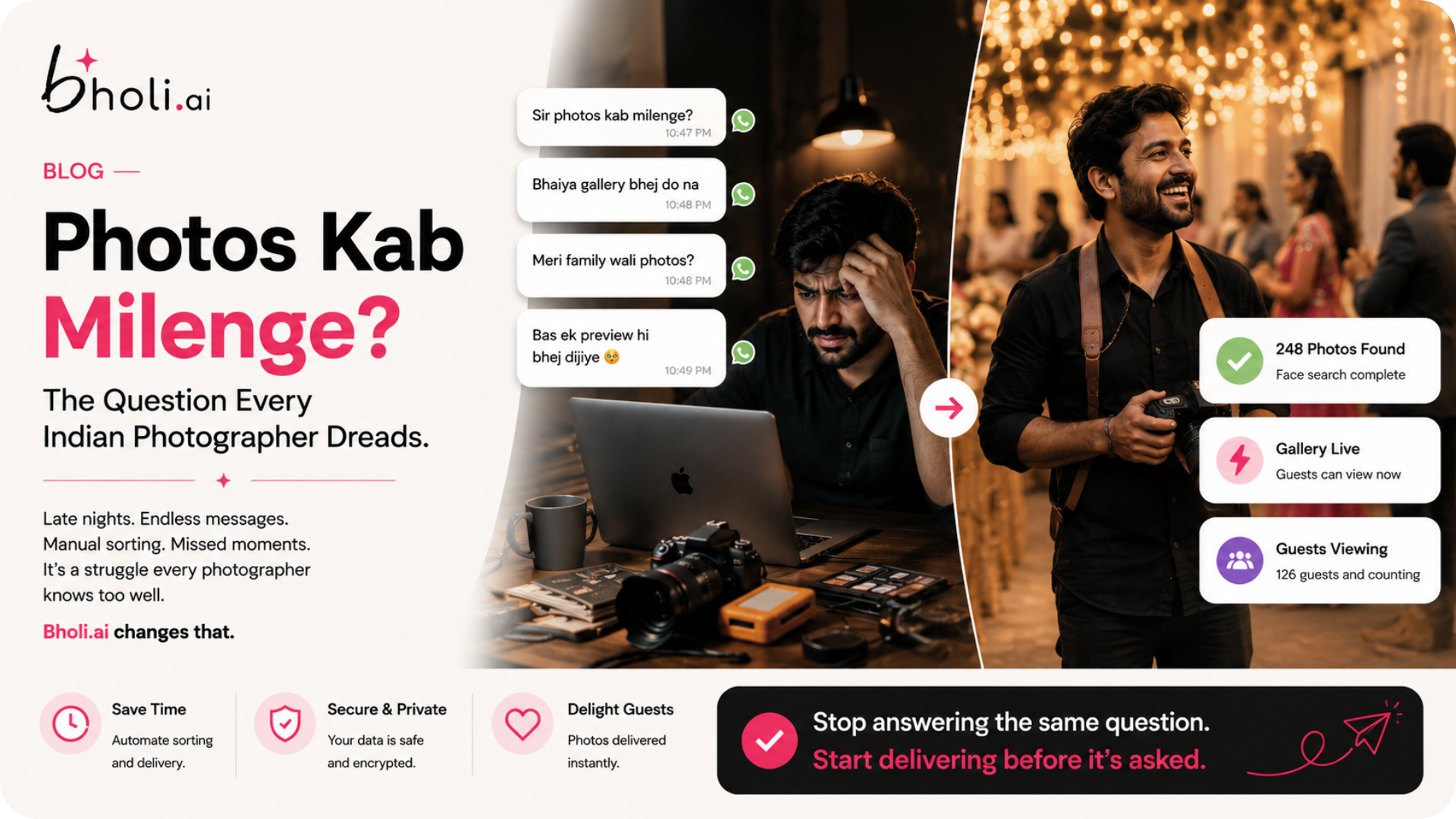
Photos Kab Milenge? - The Question Every Indian Photographer Dreads
If you've shot a single Indian wedding, you know this message. You can probably hear it in a specific relative's voice.